

Question of the Week
There are many twists and unexpected actions in Jesus’ parable of the wedding banquet in our Gospel this Sunday. See if you can name a few of them.
Are All Welcome in the Kingdom of God?
Our Gospel taken from Matthew 22 picks up where it left off last week. If you recall, we heard Jesus talk about the parable of the vineyard. The tenants wanted the vineyard for themselves and did not honor or respect the king or his son. They did not have a good end. The same was true for the invited wedding guest in Jesus’ parable this Sunday. He did not have proper wedding garments, and so he was eternally bounced!
The parable pointed out God’s desire for everyone to participate in the wedding feast of his Son, but true respect of God and the nature of the wedding itself demanded something from the invited guests. They needed to attend the wedding wearing proper garments, which in the case of this parable, represent righteous deeds and self-less love. This is a good reminder to us that a person’s confession of faith is not sufficient for salvation, but only faith working in love. We must let our faith and hope move us to deeds of charity. When we reflect more deeply on the boundless charity of Jesus, our Bridegroom, whose own pierced and wounded flesh became his garments of righteousness, we are moved to imitate him.
Pilgrimage to Medjugorje and Lourdes
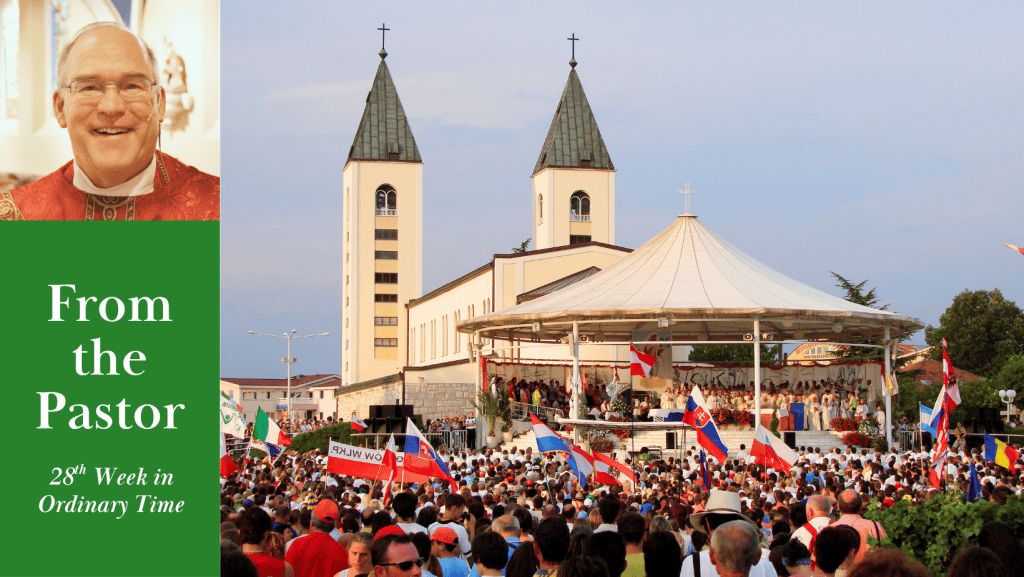
I travel this week to Bosnia-Herzegovina and the village of Medjugorje with a large group of pilgrims from various parts of Michigan and other states, and then on to Lourdes, France. Both places are very special pilgrimage sites with millions of people from all over the world coming together to pray. They do so because of the invitation they have received from our Blessed Mother and the wonderful events that have occurred there. Both places have documented spiritual and physical healings as well as conversions to a deeper faith in God.
When I return, I will share more about Medjugorje to help prepare everyone for Marija’s visit in November. We have the registration for that event available now, and I want to give parishioners a first opportunity to come.
Some have wondered what the Church thinks about Medjugorje. Is it an approved apparition? The Church has been discerning Medjugorje since it began in 1981. At this time, it has received the nihil obstat, which means there is no obstacle for believers to participate in devotional elements related to the events there, or to accept the private revelations purported to have come from Mary. Today, a Vatican observer reviews all public messages from Marija that she claims to receive from Mary and gives their nihil obstat before they can be published. Here is a link to a more extensive discussion on Medjugorje by the Dicastery for the Doctrine of Faith, which oversees such mystical phenomenon: vatican.va/roman_curia/congregations/cfaith/documents/rc_ddf_doc_20240919_nota-esperienza-medjugorje_en.html
On Marija’s part, like other Marian apparitions, the Blessed Mother set the time when Marija will “see” her, which happens around 6:40 p.m. Croatian time. However, this time is more related to the visionaries themselves and where they happen to be in the world. In other words, the Blessed Mother chooses to appear to Marjia or the other visionaries in a way that accommodates their circumstances, but it nearly always is around 6:40 p.m. (or 5:40 p.m. if daylight savings time is taken into account). It is a mystical experience in which Marija goes into what is known in Catholic mysticism as an ecstasy, where Marija loses conscious awareness of this world and becomes intensely aware of our Blessed Mother. These experiences have been extensively studied over the years by doctors, scientists, and psychologists, who have found that the visionaries of Medjugorje are not lying, are not hallucinating, and are not conjuring up their own inner experience, but are having an experience that comes from outside themselves. When the visionaries are together and Mary appears, their eyes all focus on a particular point, even though no one else can see what they see. They have been prodded and touched and light has been shined in their eyes during the time of apparition, and they do not react as we would react to such a stimuli. However, mystical experiences can vary in degree from person to person, and so a degree of subjectivity always enters in. That is where discernment of these kinds of occurrences is difficult. The Church is patient.
For example, Our Lady of Laus is the longest recorded series of Marian apparitions in Catholic history. Our Lady appeared to a young shepherdess named Benoîte Rencurel from 1664 to 1718 in the remote valley of Saint-Étienne-le-Laus, France. It was not formally approved until May 4, 2008, even though locally it was accepted as true by many believers and helped them live better lives! The visionary Benoîte Rencurel had daily apparitions for a time, and then very frequent apparitions of Mary, St. Maurice, and Jesus until her death 54 years later. Benoîte was declared venerable by Pope Benedict XVI in 2009.
As I mentioned, I will help prepare the parish for Marjia’s visit and would be glad to answer any questions you may have concerning this. All questions are welcome! You will be in my prayers!
– Fr. Bill