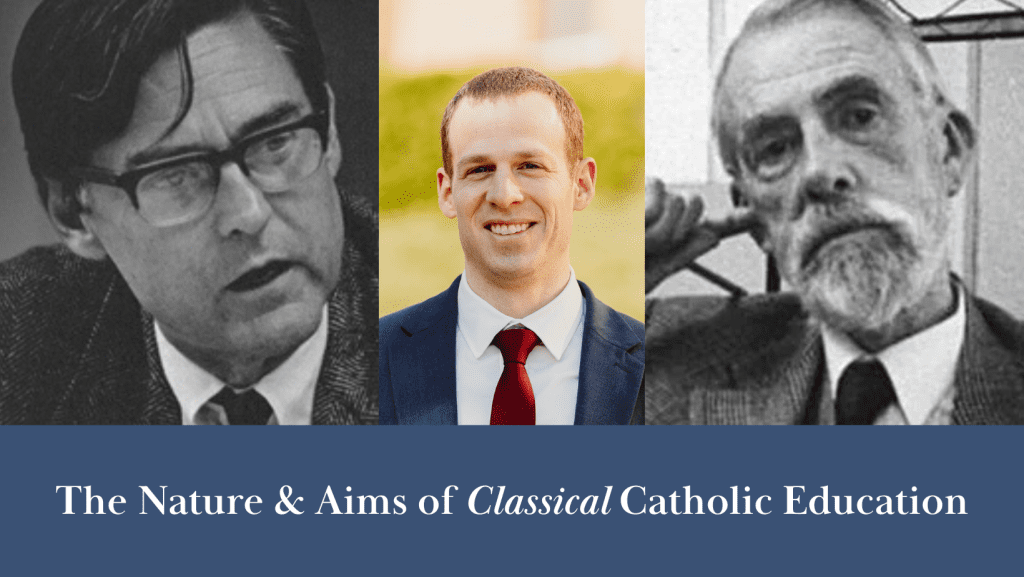
The headmaster of St. Thomas the Apostle Catholic School, Michael Sauter, gave this talk to our parish and school community on October 13, 2025. In it, he draws from Christopher Dawson and John Senior, to address our classical school’s distinct mission and why it is worth supporting through the Stewardship for Saints & Scholars capital campaign. The full text of his remarks are below.
“The beginning and middle of any order is determined by its end. The word ‘curriculum’ comes from the Latin for running a race, and a race makes sense only at the finish line. Education today simply has no finish line. A college or university is a collection of studies leading to several certifications-in history, literature, engineering, medicine, or whatever subject-but there isn’t any final cause of the institution as a whole, no principle of integration, no ‘idea’ of a university, in Newman’s sense, no definition of the educated man, what Newman called the ‘gentleman,’ as opposed to the mere scholar, critic, scientist, technician. Like the nation itself, colleges and universities are propelled by the demands of the marketplace, pushed around by ideological pressure groups and limited by inertia-they have no definition.” – John Senior, The Restoration of Christian Culture
As Dorothy Sayers observed in her well-known talk “The Lost Tools of Learning,” it is a tendency for mere “amateurs” (that is, pretty much everyone) to have an opinion about education. After all, all of us have been through one form or another of schooling. We have all of us experienced its variegated impact – good and bad, joyful and painful, valuable and worthless. And I would submit that, if we compared notes, our experiences, at least as to the objective features of our education, would be largely the same. I daresay that this would even be true between a public and Catholic educational experience.
There is, after all, a general set of expectations ingrained in American culture about what ought to be included in a “normal” school experience, and these expectations are shared by Catholics and non-Catholics alike. I will call this approach to education the “conventional.” I do not feel the need to delve too deeply into this side of things. To recap briefly, this approach to education in America has had the ascendency for around 100 years, and its godfather is John Dewey, the pragmatist philosopher who wanted (and largely got) a public school at the service of the American democratic ethos. On this model, education is not about pursuing truth, but about generating an experience by which young minds will enter into the “pooled intelligence” of the democratic community and help forward its progressive mission. In practice, over time, this has turned education into a very practical, even utilitarian affair, subject to the values of the social consensus. I daresay that the experience most of us had in schooling was one heavily invested in socialization and hence driven by the trending social ethos, as well as one marked by a high sensitivity to social “success,” measured largely by money-making.
In practical terms for K-12 education, this has simply meant an education geared toward success at the next level above it. This has made colleges and universities have an oversized influence on the entire educational system, since everyone is ultimately clambering to get through their doors, which have, up until recently, represented the very gates of paradise, as it were–the entrance into the American dream.
Now, in the last 30 years or so, a K-12 educational movement calling itself “classical” has emerged among homeschoolers and brick-and-mortar schools, both Christian and non-Christian. Catholics started to jump on the bandwagon by the late 90s. The movement originally drew inspiration from Sayers’s talk/essay and from C.S. Lewis’s The Abolition of Man. Sayers’s essay set forth the trivium-grammar, logic, and rhetoric-as “stages” in a child’s educational development. C.S. Lewis’s short book focused on the absence of the development of the heart in education (producing “men without chests”), a lack of love and perception of what is objectively noble and beautiful. Building on the ideas of these works, this movement has developed a set of common aspirations, of which the following are perhaps most central:
- To recover something that has been lost in conventional education, summed up by the word “classics.” This implies favoring certain texts and pedagogical approaches deemed “classical” or even “old school” – by which is meant more than 100 years ago.
- To question basic educational assumptions in conventional education, particularly those drawn from the utilitarian and pragmatic focus I briefly described. In place of these, to aspire after what is worthwhile for its own sake.
- To restore a sense of transcendence, human nature, the language of virtue, the moral law, etc.
- To model education on the liberal arts-the trivium and quadrivium-and to include Latin and/or Greek in some way.
Despite these common threads, there have been plenty of divergent interpretations of what “classical” means and how it applies to a school today. It is, after all, natural for a movement seeking to revive something from the past to struggle with arriving at an authentic, coherent identity, since, at least initially, it lacks the organic link that is necessary for the handing on of a tradition. The movement has been bogged down by debates over terminology and “canons,” by what constitutes a genuinely classical curriculum. I believe, however, that the Catholic school possesses the key to solving this conundrum, since it is only the Church that maintains within herself a living tradition that includes the classical intellectual tradition, one that she historically took up into her life to serve the passing on and development of the Faith.
I maintain that a “classical Catholic” education is one that, rooted in the sources and tradition of Catholic culture, draws students to a love of God and an integrated vision of reality by way of the liberal arts. There are three main aspects to this definition. First, it is an education rooted in a specific tradition. Second, the means by which it pursues its end are the liberal arts-developing these arts in students brings about the desired formation of the mind and heart. Third, and most importantly, we have the end, the aim of it all: the love of God and the inculcation of a way of seeing.
So what might this education look like? Particular characteristics include studying history instead of social studies, memorizing and reciting poetry, cutting out worksheets and leaning into developing habits of conversation, listening, and reciting lessons and stories from memory, having a robust sense of the teacher as a “master” whom the students are called to copy and emulate, replacing “science class” in the grade school with the study of nature, teaching formal grammar, logic, rhetoric, and Latin, cultivating the practice of disputation, and reading whole works rooted in the tradition-classical and Christian together. These are pieces of a distinct classical Catholic whole. More generally, on the natural level, it is an education that emphasizes immediate engagement with reality and other persons, a poetic grasp of reality, a formation of the imagination and affections according to what is objectively good and beautiful, the training in piety, studiousness, and other foundational virtues, delving into rich and complex texts, include primary sources, across subjects, developing a mastery of the written and spoken word, a mastery of the arts of number, and a mastery of perceiving what is most worthwhile. Above all, it is an education utterly dependent on the Sacrifice of the Mass, on prayer, and on the sacraments, receptive to the deep sources of Tradition by which the Fathers, Doctors, and Saints teach us how to pray, read Scripture, and live. It is a contemplative, personal, rhythmic, and joyful education, one marked by both rigor and delight, developing a philosophical caste of mind summed up by the word “wisdom.” That word, I believe, when proposed as an end with real content, makes clear the divergence between the classical and conventional approaches and ends.
Though there is plenty more to unpack in what I have said about the classical movement in general and about my definition of “classical Catholic” education, I would like to jump right to the two men who, more than pretty much anyone during our long exile under Dewey-inspired education, saw deeply the link between culture and education, between tradition in education and a truly living Christian life and faith. I believe that their visions will help us to frame our definition and cut through the endless debates around terminology that have bogged down the classical movement both within and outside Catholic circles.
In many ways, these two were quite different. Christopher Dawson is perhaps the preeminent historian of the 20th century. Born in Wales in 1889, he attended Oxford, but became an accomplished and widely recognized historian through his own studies rather than pursuing a doctorate. In his 20s he converted to the Catholic Faith, and it became his great project to show the importance of Christian culture for the modem West even as it was suffering the catastrophes of the World Wars. His work and reputation led to his being invited to Harvard to chair a newly formed department in Roman Catholic Studies in the late 1950s. He worked to bring the modem studies of sociology, culture, and history into conversation with the Catholic tradition, hoping thereby to maintain that tradition as a living force in Christian thought and education.
In his work The Crisis of Western Education, Dawson focuses on the role of formal education in passing on the ideas and values of a culture. He points out that the old humanist-that is, classical-education that survived into the early 20th century was rooted in the culture of the Classical Age of Ancient Greece and Rome. But this culture is definitely past and not a living thing, even though its imprint on Western culture continues to be felt. On the other hand, Catholic culture is something still living-the Catholic Faith still inspires people to live in particular ways and to draw from the sources of the Faith and worship as from living fonts. A Catholic education ought to be a humanist, classical education, but rooted not simply in the Graeco-Roman sources, but in the “classics” of our Christian past-the Church Fathers, the monastic tradition, the doctors and scholastics, the great saints, as well as the great works of Christian art and literature. “What is needed is a reorientation of higher studies with the concept of Christian culture as the integrating factor-a new system of humanist studies oriented towards Christian culture rather than classical culture in the old style or the contemporary Western secular culture in the new style.” This doesn’t exclude the Greek and Roman sources-on the contrary, it gives them a new and higher role, where their beauty and transcendence can, as before, have a living impact, but now as part of a formation handing on a Catholic vision of man and reality.
Historically, Dawson was pointing to an intellectual tradition that had undergone organic development at least since the Classical Age of Ancient Greece and Rome. This tradition developed an education geared towards pursuing transcendent truth, goodness, and beauty, an education summed up in the “liberal arts.” These arts were carried on in the West by the likes of Boethius and Alcuin, and the intellectual tradition they handed on was preserved and deepened through the monasteries and monastic schools, as well as cathedral schools and, ultimately, the medieval universities. It was the Church that was now the guardian and developer of this “classical tradition,” and this tradition was thereby taken up into her life and took its place as an integral part of her theology, her worship, her art, and her law. It was deepened also through a series of”renaissances”–the Northumbrian, Carolingian, 12th-century, and Italian, this last providing the spur for the flowering of the “humanities” and the fuller ideal of the “gentleman.” In the 16th-18th centuries, the Jesuits became the premier schoolmasters of Europe through their grammar schools, academies, and colleges. They were the ones chiefly responsible for bringing this “classical” or “old humanist” education into modem times, such that even Dawson himself still was a receiver of it when he was young, before it succumbed to the mounting wave of progressive education. All of this Dawson ably traces in his book.
Dawson was an academic historian who saw history with penetrating vision and who had a deep love and understanding of the past, which was something very much alive to him, especially as it was, in a sense, the past of the Church: “For the Christian the past can never be dead, as it often seems to the secularist, since we believe the past and the present are united in the one Body of the Church and that the Christians of the past are still present as witnesses and helpers in the life of the Church today.” It is his historical emphasis that helps cut through the agony over terms and the word-salad trap. After all, he is not simply working in the conceptual world of educational programmers, but the world of a living tradition. He is pointing to an education that, though in some ways new, stands in organic relationship with an older education and with a real past.
It is in this emphasis where he and John Senior closely meet. Yet how different was the path Senior took to get there! He also was a convert, but not simply from Protestantism, but from an agnostic positivism that had nearly led him to despair. Senior had touched something good through the influence of his teacher at Columbia, Mark van Doren, the same man who was influential in bringing Thomas Merton to the Faith, despite himself not being Catholic. He was simply someone who opened up the world of classical literature and philosophy, and these were the areas on which Senior focused on his way to earning his Ph.D. in the 1940s. By the 1950s, he was well on his way to converting to the Catholic Faith. He was especially influenced by his reading of St. Thomas Aquinas and his vision of moderate realism that cut through the sophistry of radical existentialism and skepticism.
Senior had always loved cowboys and the American West, and after some stints at eastern universities, that is where he ended up, ultimately settling at University of Kansas where he, along with two other professors, founded the Integrated Humanities Program (IHP) in the 1970s. For nearly 10 years, he ran this program, running class as a dialogue with the other professors, discussing great works of western literature and philosophy, leading students to memorize poems, star-gaze, dance, and sing. In this way, he became a major influence in the conversion of many of his students to the Catholic Faith, and this was also a major cause for his program to be shut down by the university.
In his two main works, The Death of Christian Culture and The Restoration of Christian Culture, Senior presents in forceful terms the dire situation of Western culture, already “dead” for having abandoned the Faith and the sanity, beauty, and moral drive it provided. He called for a radical reexamination of how we approach education, that culture-shaping institution: “The crisis in education is really the result of a general cultural depletion, and nothing short of a genuine restoration will work any real improvement. And that is no matter for methodology; it is a deeply philosophical, historical, religious, and personal matter, going down to the roots of our civilization and ourselves” (Death, 95). He didn’t just call, however-he also led a radical change, right in the midst of a secular university!
Indeed, his IHP represents his attempt at that “restoration,” an education that was truly integrated and formed according to its proper end. To illustrate the true meaning of “integrated,” Senior points out that no amount of extending a carpenter’s knowledge will ever capture the broader understanding and vision of the architect, who sees the reasons for the carpenter’s craft and its integral place in the broader whole of the building. Senior compares the 7 liberal arts – grammar, logic, rhetoric, arithmetic, geometry, music, and astronomy – to so many stairs by which a student ascends to a transcendent vision of reality, He then reflects on what “comes next,” as it were:
The brave young man at the top of the stairs must now descend to wherever in the scale of work his talents lie, learning how to do one thing in the daily practice of an art or craft, but having a vision of its place in the universal scheme of things in which architects cannot be arrogant or carpenters envious, because they are both parts of something greater than themselves. That is the difference between a technical school and a university-the university is supposed to rise to the universal. It integrates the horizontal and the vertical. It is a place where ”young men see visions, and old men dream dreams” (Death, l00).
The liberal arts are not merely subjects, but arts of the mind. Just as a particular physical craft or visual art has its corresponding product, so also the liberal arts have products-their distinct formation of the mind, seen in habits of thought and ways of seeing reality. They are liberal because they are not burdened by utilitarian considerations; rather, they open the door to transcendent reality and the freeing of the mind from being bound by only particular, calculating considerations.
I myself experienced something of this kind of education through the Humanities and Catholic Culture Program at Franciscan University. It was in this course of study that I was introduced to Dawson by the program’s head and originator, Professor James Gaston. The program changed my life. I was already a committed Catholic coming into it, but, through it, I was set on fire to pursue the truth and a vision of reality as an integral part of having faith, whereas before, I had struggled to find a source of integration among faith, life, and academic work. And so it is that I am seeking to hand on what I received, and to bring to life once more the vision that lived in my teacher. It seems to me that in that experience, I discovered the heart of what education really is. Senior recalls Plato in this regard: “Teaching, Plato says, is a species of friendship, whose highest degree is love” (100). It was so for me-I was brought to love truth in a profound way that drew me on to greater depth and beauty. It wasn’t merely that I was taught to “think for myself’ or develop “critical thinking skills” by participating in numerous “seminars” and class discussions. The classical Catholic education we’re talking about here is much more than just working through the “great books” and conversing about them. There must also be a teacher who possesses the fire, as it were, that is to be handed on. Senior capture this point powerfully:
I’ve seen it happen again and again as you do in the Dialogues with Socrates, when a good teacher, carried away by the sight of beauty, good or truth, cuts through the “I think, you think,” to prophesy like Jeremiah with the overwhelming doom of certitude, which settles over the silent table like the descent of the Dove, and we repent our egotistical opinions and values and blush in the shame of pure, simple, incandescent assent. “That is true,” we say, “that is really true.” And that is the experience you never forget in a real liberal education, and when it happens once you will suffer hours of failure and frustration in seminars and class discussions in the hope the fire will strike again. And if that never happened, you haven’t had an education at all (Restoration, 117).
And so, returning to our definition, I think we can begin to see how these two thinkers help us unpack its elements: rooted in tradition, proceeding by way of the liberal arts, and oriented to the love and vision of God. This last, education’s end, is reiterated with great clarity by Pius XI in his 1929 encyclical on education (still the only one of its kind), Divini Illius Magistri:
In fact, since education consists essentially in preparing man for what he must be and for what he must do here below, in order to attain the sublime end for which he was created, it is clear that there can be no true education which is not wholly directed to man’s last end, and that in the present order of Providence, since God has revealed Himself to us in the Person of His Only Begotten Son, who alone is “the way, the truth and the life,” there can be no ideally perfect education which is not Christian education. – par. 7
I would maintain that, among educational approaches today, only a classical Catholic education can authentically, integrally, and holistically pursue this sublime end, bringing faith and reason, the natural and supernatural, nature and grace, into a harmony without collapsing one into the other. I would further maintain that the attempt to happily marry this end of Catholic education with the conventional, Dewey-inspired approach has not worked, involving as it does too many incompatibilities in vision and priorities.
I am aware that these are large claims and that I haven’t the time to make good on them in anything approaching a satisfying “proof.” I have seen the insides of a number of different schools and educational training programs, and I have seen how the conventional approach-the one with which we are all relatively familiar-lacks an integral unity and a coherent end. It does not proceed from a clear sense of tradition and culture, it does not proceed by way of the liberal arts, and it is not inherently oriented to the love and vision of God, even though I know that this last piece is where many Catholic schools attempt to insert a new direction. The problem in that Catholic attempt, broadly speaking, is that it doesn’t really address the other two elements. We are still adrift, and we still lack an education that truly corresponds to the human person and his pursuit of what is true, good, and beautiful.
Dawson and Senior both called for a radical reconsideration of Catholic education, that is, a reconsideration that would get back to its roots and reground itself in a tradition inherently alive. This is our project at St. Thomas. I would hardly call us a perfect model. But I will say that we are looking for and hiring those teachers that carry a love of this living tradition within them and can communicate that love to their students, as my teacher did at Franciscan. We are looking at the contemporary, conventional models around us not as standards by which to measure our own progress, but as generally failing projects that have hit a dead end. However, far from making us elitist, this stance deeply challenges us and shows us our own poverty-what a work we are taking on, in attempting to graft ourselves once more to the rich tradition of education that was once found in the cathedral and monastic schools of Europe, in the great medieval universities, in the academies, colleges, and grammar schools that were so ably organized by the Jesuits! No, we feel our inadequacy, I assure you. But in our poverty, we hope to make room for the grace of God to work.