November 13-14, 7:00 p.m.
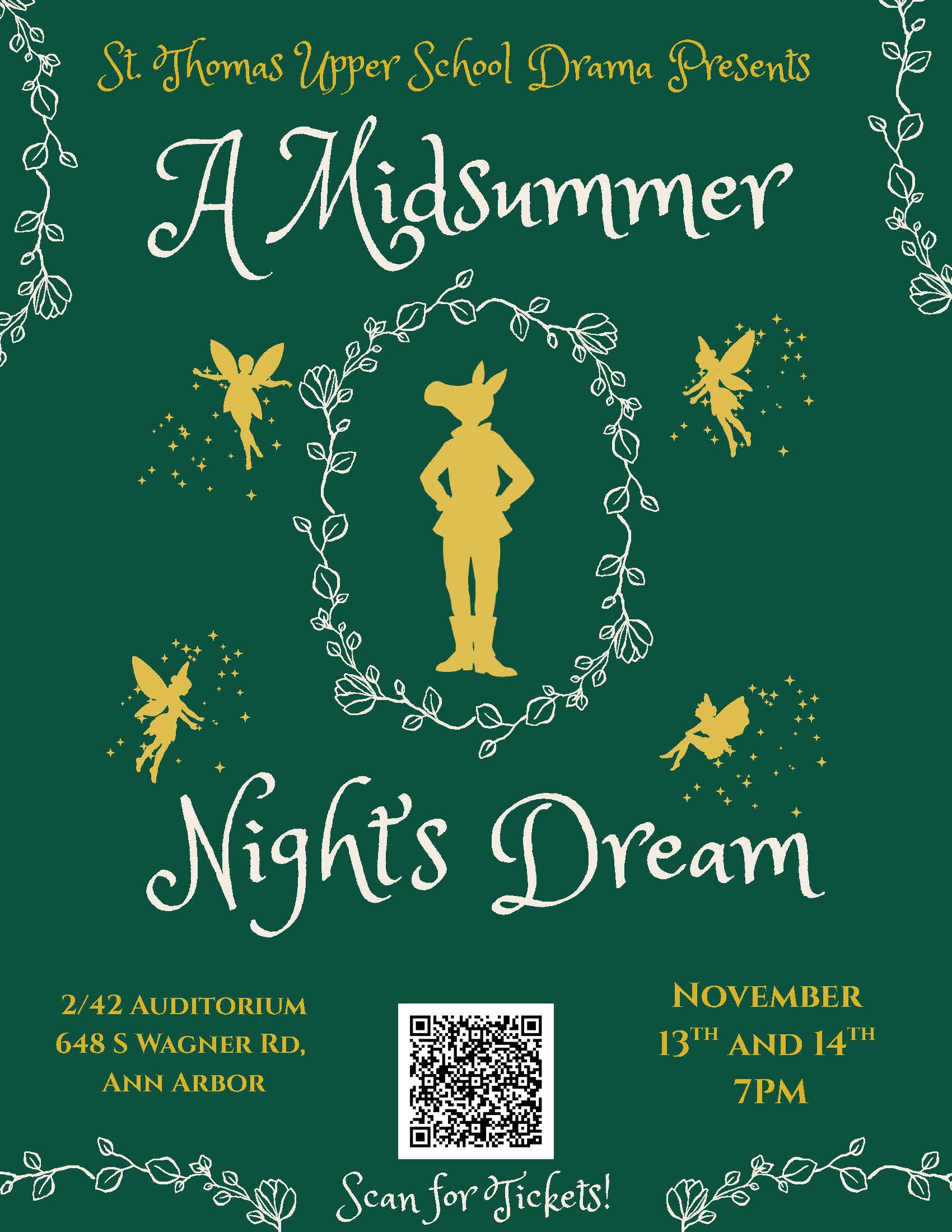
Shakespeare’s most popular comedy is filled with love triangles (and rectangles), magic, drama, donkey heads, and a terribly acted skit! The St. Thomas Upper School is so excited to bring you this famous fairy tale.
Shakespeare’s most popular comedy is filled with love triangles (and rectangles), magic, drama, donkey heads, and a terribly acted skit! The St. Thomas Upper School is so excited to bring you this famous fairy tale.
Come and experience a high school that isn’t about jumping through hoops, but rather about formation in a whole way of living!
St. Thomas Catholic High School is a small, challenging, communal school that genuinely forms the whole person and helps young men and women become disciples of Jesus Christ. This is accomplished through a trifold approach of classroom, immersion, and apprenticeship.
By the grace of God, we just concluded the 158th school year for our parish school. Yet it was also a year of significant “firsts”—our first as a full PreK-12 classical Catholic school and our first graduating senior class.
We are pursuing something unique in our diocese: a renewal of the K-12 parish school model. This allows our parish school to form young souls during that vitally important time when they are transitioning into being young men and women. Indeed, the classical Catholic formation is one that naturally carries into high school and beyond.
Now four years into the “high school project,” we are already seeing its fruits among its students and families and for the entire school culture.
Looking back over the four years his son James spent at our school, Kurt Hiester recognized the impact of this formation. “St. Thomas has been transformative for my son. This is a school that looks beyond simply churning out students who get good test scores or are admitted to select colleges, but asks itself, what is it that makes a person excellent, and then goes about very intentionally helping its students to pursue that goal. And it does those other things besides!”
Parishioner Erin Deemer, mother of incoming 10th and 12th graders, noted the “spirit of joy and camaraderie among the students who care about each other and enjoy spending time together.” This camaraderie has become a stronger feature of our middle- and upper-school culture, seen both in the classroom and in household life. It is also an outflow of the central place that the Mass, the sacraments, prayer, and the pursuit of the truth in love all play in forming students.
Jonathan and Maryn Hasey, homeschooling parents whose daughter just completed her freshman year after joining St. Thomas last fall, were thrilled with the decision to try a full-time school for their oldest. “St. Thomas has been such a blessing for our daughter. The careful and personalized care of the teachers has helped her grow academically, but also in character. Additionally, the camaraderie of the students is a joy to witness. We are so happy we decided to give the school a try!”
The support of the parish for its school has made this formation possible. On top of regular giving, both the gifts offered for our Stewardship for Saints & Scholars capital campaign and for our school gala this past April were a testimony to the integral place our school holds in our parish mission. Indeed, the diocese makes clear that the parish school is the single most important outward-facing parish apostolate.
Your generosity has a real impact. A large portion of the nearly $2.5 million raised thus far for Saints & Scholars will be invested in our school endowments, which will help us compensate teachers and make the school affordable over the long term. Our gala also supported those two goals, but with a more immediate impact in mind as we continue to grow as a PreK-12 school. Through the generosity of parishioners, school parents, and others, along with a generous donor providing a $50,000 match, we were able to raise over $100,000 to support a more aggressive pay scale, along with around $45,000 to supplement our student scholarship fund.
As we continue to be joined by new families at all levels of the school, we look forward to hosting our 29 enrolled preschoolers, 118 enrolled grade schoolers, and 19 enrolled high schoolers this fall!
May our Lord and his Mother continue to carry us as we seek to glorify God and lead souls to him.
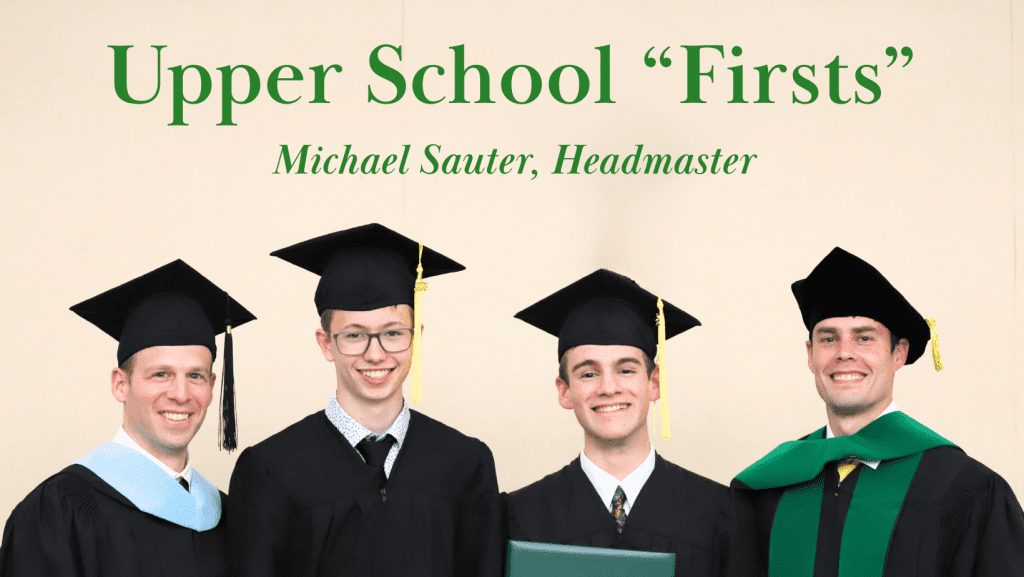
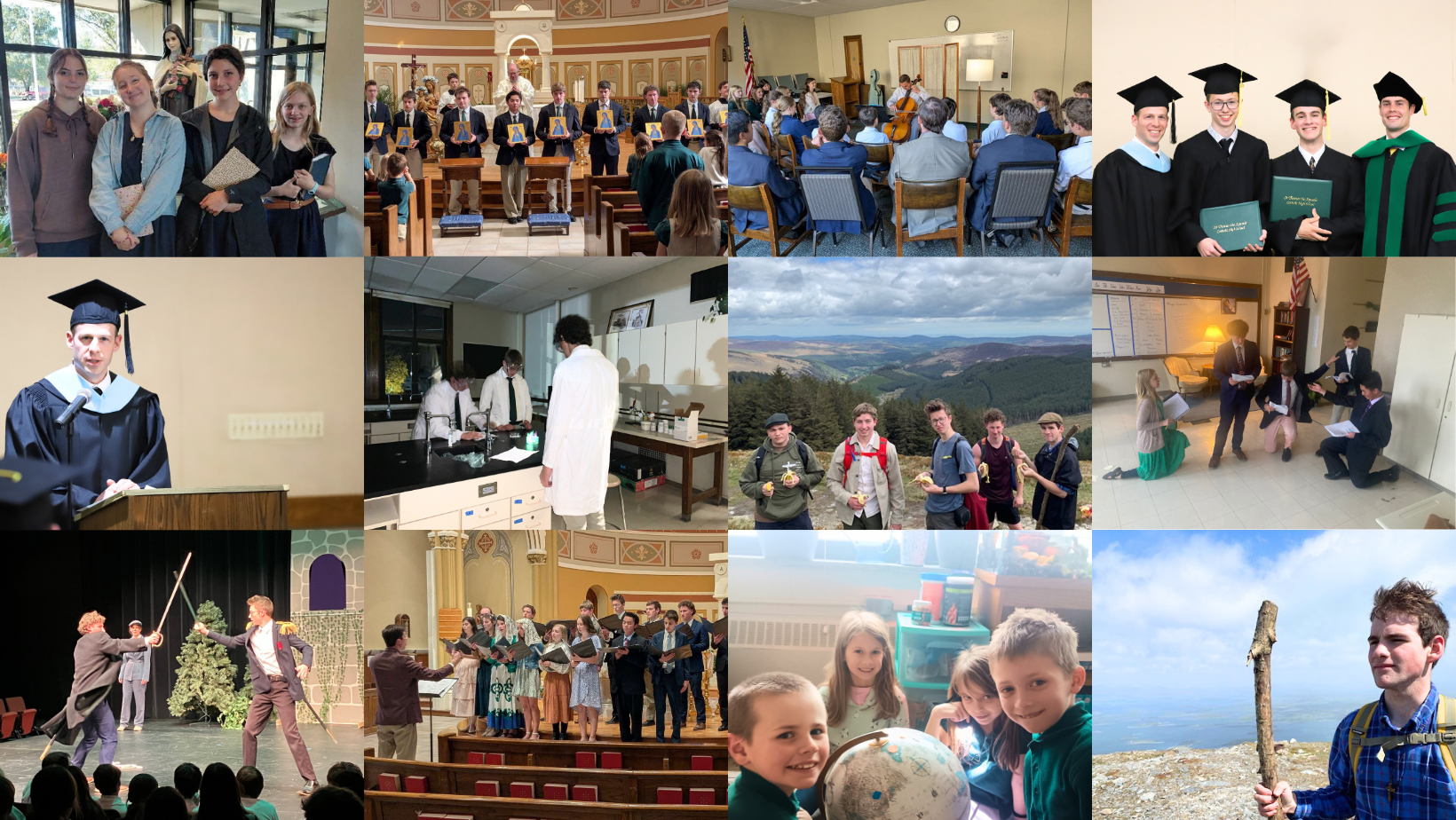
Capstone Thesis and Defense: Under my direction and that of their respective thesis advisors among the faculty, our two seniors each completed a 13-18-page research paper and publicly defended it before a faculty panel this past spring. The paper was to address an event, idea, person, movement, etc. in history that reveals some aspect of Catholic culture and its development. Paul Restuccia wrote about the Church’s engagement with various forms of media, with a special focus on the 20th-century. James Hiester tackled the advent of eugenics and the Church’s response in the 20th century.
Ireland Pilgrimage: Parishioners and others in the Catholic community were very generous in supporting our juniors and seniors (all young men) to go on a week-long pilgrimage to Silverstream Priory in Ireland this past May. Led by our Dean of Student Formation Joey McCoy and upper-school teacher Christopher Woods, the students experienced the rhythm and silence of monastic life while also branching out to the surrounding area for day pilgrimages, sight-seeing, and hikes. The goal is for this pilgrimage—and a comparable one for our young ladies—to become a regular “capstone” experience for our students, something that represents the heart of what we are trying to give them at St. Thomas.
Senior Graduation: Our inaugural senior graduation was held in the parish hall on May 29. Fr. Gerald Gawronski delivered the commencement address for our two graduates. It was a solemn, lively, and joyful event all in one, with plenty of ceremony, singing, and thanks. Paul and James composed a new alma mater, “Rise up, St. Thomas,” which was publicly sung for the first time that evening. It has been a great gift to see the ways in which God has worked in these two young men over the past four years. I couldn’t have asked for a better first graduating pair! Paul is attending Hillsdale in the fall. James was accepted to Benedictine, University of Dayton, and Michigan Tech. He will be taking a gap year to discern next steps before heading off to college.
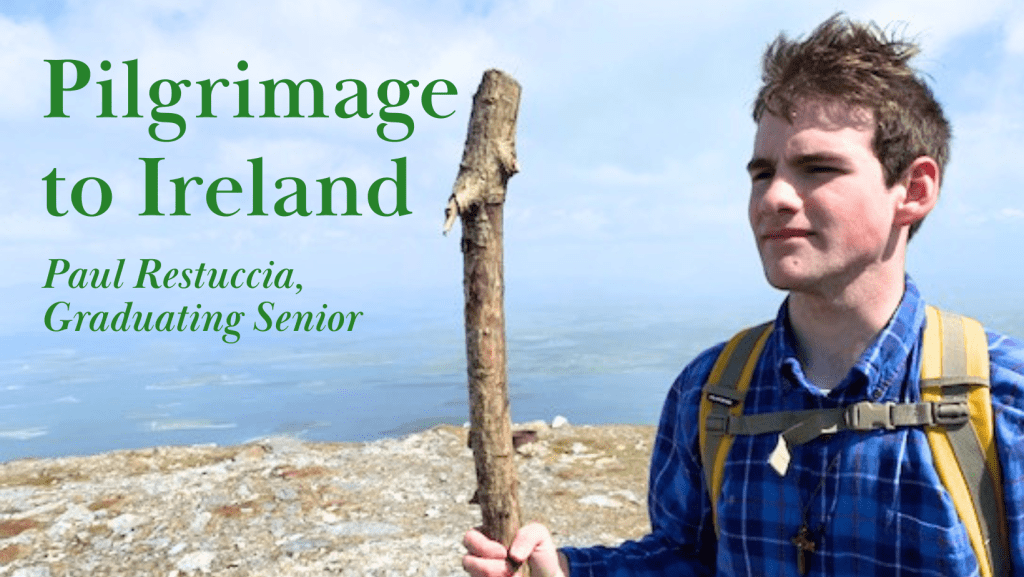
In the Silverstream Priory of Ireland, the Benedictines live their lives separate from the world, informed by the centuries of tradition and deeply engrossed in, and reflective of, Catholic culture. There were many factors and experiences there which convey this point: the Divine Office, the Great Silence, the eating of meals, their work, etc. Everything seemed to be partaking of an invisible reality. The Divine Office acts as the anchor for the day, as everything is scheduled around it and it gives the day structure as well as a special peace and spiritual harmony. This peace is an essential aspect of the monks’ lives, as while they work, while they eat, and during the entire evening and morning, there is a kind of silence that permeates and allows for greater union with God at all times. The monks referred to the Great Silence as “an act of charity” allowing one’s neighbor time with God. All of this—the liturgy, the peace, the work, the meals, and everything else—is ordered towards that divine life. It isn’t concerned with mundane matters and isn’t “solicitous for the morrow.” They just live in Jesus, through Mary.
The Benedictine way of life is revelatory of Catholic culture’s heart, in that it encapsulates, distills, and exemplifies how all Catholic culture ought to be. The way they pray the Divine Office, its regularity and rigor, is meant to reflect how every Catholic should consecrate their whole day to God. The silence and peace they inhabit is meant to reflect the peace that should dwell in every Catholic heart. And their lack of anxiety and trust in God reflects the leisure which every Catholic ought to exhibit when living the simple Christian life. These examples, out of many more, show forth how the Benedictine way of life is an incarnation of the Christian life ideally. It isn’t that every man is called to be a monk, but that what is essentially at the heart of monastic life—peace, prayer, and trust in God—really is essentially at the heart of all Catholic culture.
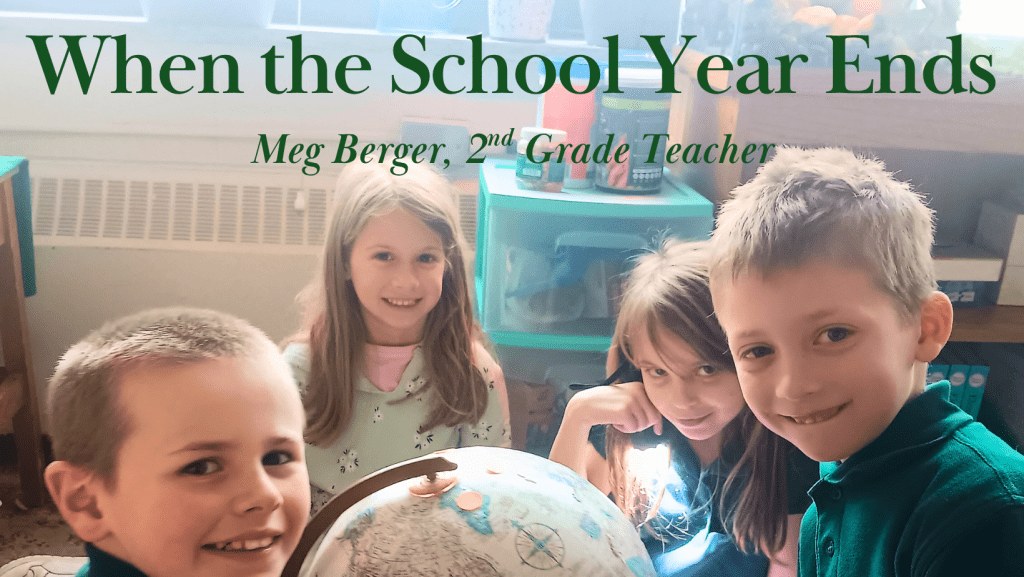
Windows closed? Check. Fourteen desks, cleaned and emptied? Check. Artwork—Adam and Eve, the Flood, a Sargent print, portrait of Louis XIV—all put away? Check.
Empty chairs, stacked. Sound City safely pulled down, all its phonetic houses laid safely to rest in their proper folders. Math manipulatives—counting cubes, base ten blocks, school money, clocks—all labeled and stored, left hibernating in their cupboard like a bear.
As a teacher, there is something unnatural and bereft in the closing of the classroom.
Have I looked forward to summer? Yes—this year it seemed more than the students, who made exaggerated sad faces every time I told them the end of the year was coming, and who re-wrote the day count from “179” to “1” as we neared the last day.
But the purpose of the classroom is to be full. The counting cubes ought to be in a student’s hands, as little fingers pull apart and combine, touch informing brain that “three and five are parts of eight.” The books that I am covering on shelves ought to be read, quietly by an entranced girl in one of the reading nooks, or at the back table by three eager boys, delighting in the eternal misadventures of Peter Rabbit.
Speaking of rabbits, there is a friendly, big-eyed cottontail in a lavender hutch—he needs to leave school, too. No more hopping around the classroom to greet arriving students, no more sitting patiently by students’ feet in a bid for affection. Even at home with me, he’ll be lonely this summer, as well.
Empty is the big rug, where previously students gathered to read together and sing folk songs sung by generations. Little House is put away, and the notes of Old Grimes and Clementine have faded into silence.
Hesitantly, I put away the statues, prayer cards, and icons that students used to decorate our prayer table. With some pride, I pick up the scroll of our Eucharisteo—our thanksgiving list. Students worked on it for weeks prior to receiving their first Holy Communion, and together listed hundreds of things, gifts, for which they are grateful. After all, “No duty is more urgent than that of returning thanks,” St. Ambrose says. As I say, repeatedly, “God gives to us, and through joyful thanks, we give back.”
When cleaning the Nature Studies corner, I give my own thanksgiving as I clear and separate my personal victory: bags of leaves and various seed pods. A humble victory, but a joyous one; this year my students learned the names and characteristics of nearly two dozen trees. This was a new addition to our curriculum, and by the end of the year my students could identify trees regularly on our nature walks. One parent shared an anecdote about two of my students during soccer practice at a nearby park: While waiting under a tree, one student turned to the other and asked “What kind of tree do you suppose this is?” A lively discussion ensued, the two boys observing the points of the leaves and the textured bark in their quest to determine the correct species.
When I heard this story, my heart nearly burst with joy. This, I reflect in my empty classroom, is why I teach: So my students can understand reality and relate and interact with the world around them. So they can be at a park and not merely glance around at green stuff and plant matter, but look and see pattern and order and names that reflect the pattern and order that the One Name put into his creation. So they can see and know the gifts of the Lord, and offer them back with joy.
I turn to my oddly bereft room, all slumbering and silent, and really, just so wrong. And I give thanks. A good year is over. Good children have been entrusted to me, and I have returned them—hopefully better—to those who love them most. I close my eyes, fold my hands, and offer one more Eucharisteo, thanksgiving, for a year of blessings. One year is over. And next fall, another one begins.
The classroom is empty, but like all slumbering things, it will awake like Lazarus in its proper time.
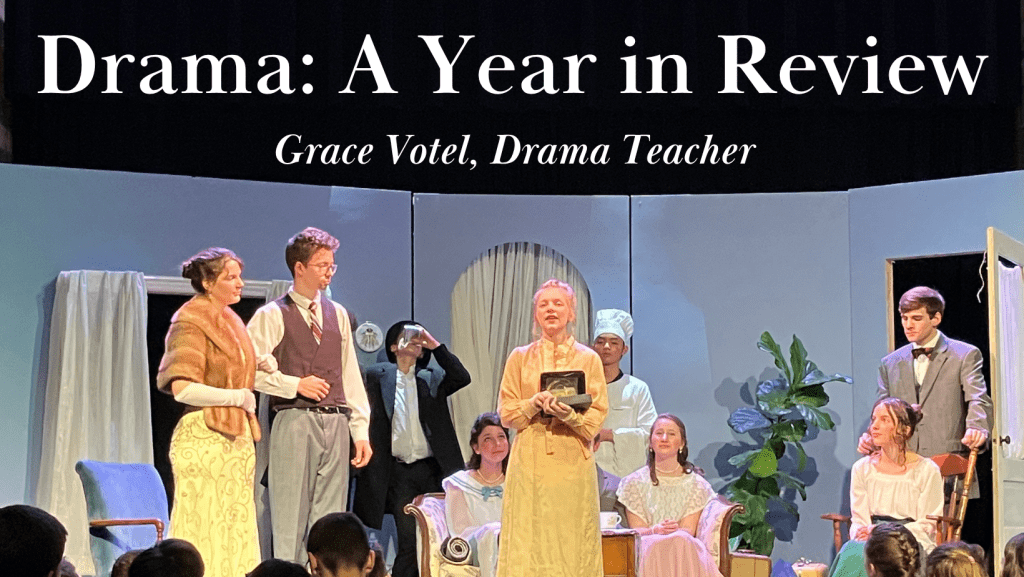
An upper school drama class at St. Thomas starts like any other: with prayer. But after we peacefully commit ourselves to our Lord, the room bursts with activity and energy. Students huddle into their production groups, where they work together on the set, the music, the props, the costumes, and more. I round up actors to go over a scene in the back of the classroom, and a contented, focused hum sets in as we all get to work. This mood is lovely enough, but usually during the class the atmosphere will shift. The hum will dissipate, heads will turn, and everyone in the room will get caught up in the scene playing out in the back of the room. It could be Ben jumping under the table, Fulton and James launching into a heated sword fight, Lydia crying over a letter, or Charlotte begging not to elope. Whatever it is, the magic starts happening. An irresistible draw of drama pulls in the spectators, and everyone has that most encouraging thought: “Ooh, I think our play is going to be good.”
This expectation was fulfilled with all three of our plays this year! I was proud, and even more importantly, the students were proud of themselves. The accomplishment was all the more glorious because the plays were not watered down “kid versions” but real, interesting, human works! The upper school drama class performed The Two Gentlemen of Verona in November and The Matchmaker in April, closely followed by our stellar middle school Drama Club performing an original play by our headmaster. Starting in middle school is a great gift; they are hungry for excellence and willing to work so hard on a high-stakes, high-level performance. They know Drama Club is a time to enjoy themselves, to use their creativity, and even to be silly, but the students are even more free to do so within the structure of my high expectations and organized deadlines. This balance of joyful inspiration and intense effort continues into upper school with more opportunities to be an actor, designer, director, or technician—all are needed to put on a show!
The mission of St. Thomas the Apostle Catholic School is to form our students as disciples of Jesus Christ, and drama has a unique part to play in this mission. You may have noticed in life that virtuous people tend to be good actors. It is hardly surprising considering the formation in self-control, compassion, patience, and courage that occurs when a student examines and consistently embodies another character. Drama teaches a person to carefully consider what they are expressing and how, a useful skill to practice if you want to go about your life expressing love and kindness. Though we should avoid “acting” loving without our hearts being in it, acting can form a person to clearly show true charity. Our students are learning this subtle lesson through something so appealing and delightful that as soon as one show ends, they start asking me about the next one! Their joy and devotion are an inspiration to me and all our audiences, and I pray the drama program continues to bless the St. Thomas community next year!
The 2025-2026 school year saw many exciting areas in which students delved into the riches of classical Catholic education here at St. Thomas the Apostle School. I was delighted to be able to see their progress in the classroom, in performance and liturgy, and in building up our school culture.
In theology class, the seniors grappled with a wide range of works spanning the Christian theological tradition and focusing on the life of grace and virtue. We began the year with St. Augustine’s Confessions, using it as a lens to consider the meaning of Christian conversion. From there, we made stops in the Summa Theologiae of St. Thomas Aquinas, considering the nature and growth of the virtues (both cardinal and theological) before turning to St. Francis de Sales’ Introduction to the Devout Life. We closed the year by turning to St. Thérèse of Lisieux’s Story of a Soul, reminding ourselves that along with all the wisdom of the Christian tradition of spirituality, it is charity that holds pride of place.
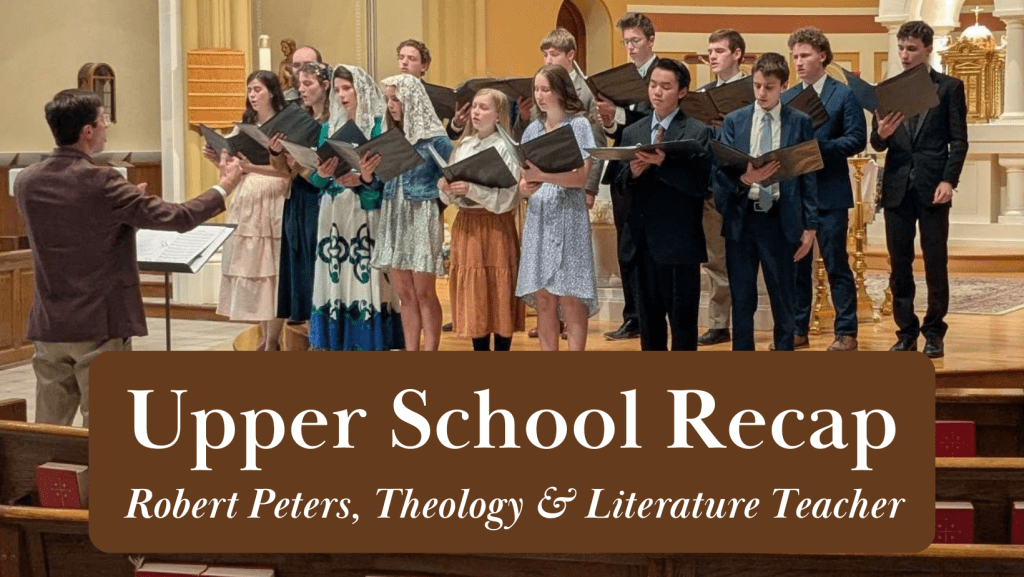
The entire school pulled off two concerts, one for the Christmas season and one for the Easter season. In collaboration with our grade school music teacher, I was able to introduce the students to many treasures of sacred music. The upper and middle school girls sang O Holy Night for the Christmas concert and Maria, Mater Gratiae (by Faure) for the spring concert, while the upper and middle school boys sang Gaudete, Christus est Natus and Te Ioseph Celebrent. It was an enriching experience of collaboration across the grades. I am particularly pleased with the upper school for expanding their repertoire, learning such pieces as Antonio Salieri’s De Profundis, Jacques Arcadelt’s Ave Maria, and Gregor Aichinger’s Regina Caeli.
The inaugural year of the upper school household system was well-received by students and helped to build up our school culture. As head of the St. Ignatius of Loyola boys’ household, I’ve been grateful for the opportunity to get to know and help form the students outside of the classroom and to see their growth as young men and friends with one another. One of the central activities we worked on as a household was learning how to engage in disputations. Over the course of the year, upper school students engaged in in-house disputations, learning how to think through and argue about topics historical, linguistic, scientific, and theological. Once a month, two of the households engaged in a formal disputation. Ignatius House was proud to be the winner of the first and last formal disputations of the 2025-2026 school year! We look forward to what the 2026-2027 academic year will bring!