
Questions of the Week
Why did Jesus ascend into heaven? Why would he not just stay with us in his risen glory?
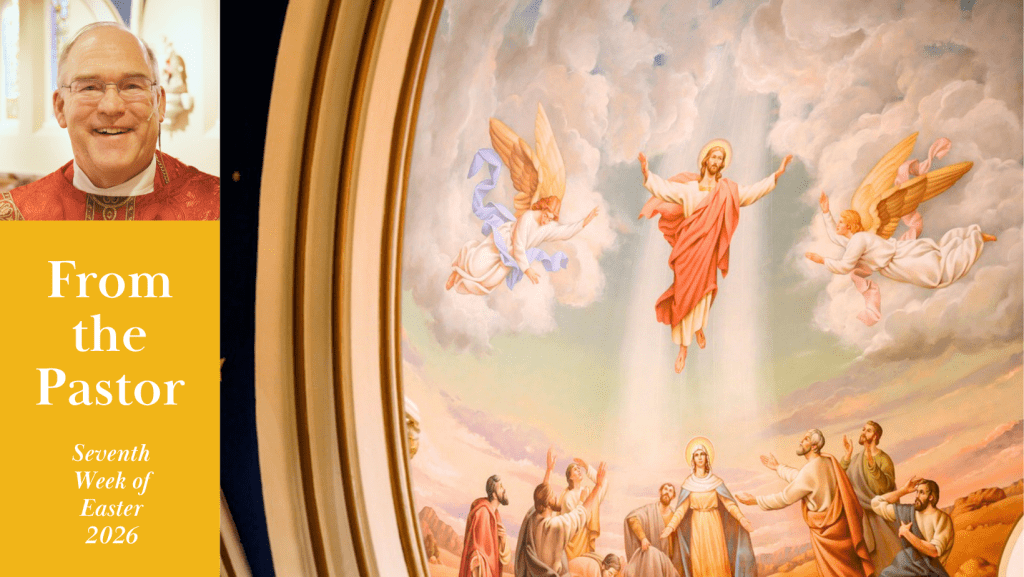
The Ascension of Jesus into Heaven
During Jesus’ ministry, he often referred to himself as “Son of Man.” On the surface, it sounds like a title of humility, like saying, “I am one of you! I am—like you—an ordinary human being, a son of Adam.” (In Hebrew, that is how it would sound: “Son of Adam.”) C.S. Lewis, in his Chronicles of Narnia, had Aslan the Lion speak to the children this way: sons of Adam, daughters of Eve. And in Scripture, in some places, the phrase is used in just that way, such as when God speaks to the prophet Ezekiel, or in Psalm 8: “What is man that God should be mindful of us, or the son of man that God should care for us?”
Yet, when Jesus used it, it had another reference that upset the religious leaders of his day—and ended up being the very reason and basis for the charge that led to his own crucifixion and death: the charge of blasphemy. Why? Because the “Son of Man” was a reference to the divine figure found in the prophetic book of Daniel, especially chapter 7. Here we have God, the Ancient One, sitting on his glorious throne, and then one like a “Son of Man” coming to him on the clouds of heaven! This Son of Man receives all dominion, glory, and kingship! “His dominion is an everlasting dominion that shall not be taken away, and his kingship shall not be destroyed” (Daniel 7:13-14).
So the title “Son of Man” refers to a divine figure who possessed the authority and power of God. When Jesus healed the paralytic, for example, he first said, “Take courage, child, your sins are forgiven,” and immediately the Pharisees were thinking, “Who but God alone can forgive sins?” So Jesus said, “In order that you may know that the Son of Man has authority on earth to forgive sins,” and he said to the paralytic, “Rise, pick up your mat, and walk!” Jesus was revealing the power and authority he had, for he was indeed the divine “Son of Man” spoken of in the Book of Daniel.
When Jesus was before the high priest and was abjured by him to “tell us if you are the Christ, the Son of God,” Jesus replied, “I tell you, hereafter you will see the Son of Man seated at the right hand of Power and coming on the clouds of heaven.” With that, the high priest tore his garments and charged Jesus with blasphemy.
Jesus is who he said he was! He is the divine Son of God!
The Solemnity of the Ascension commemorates Jesus completing the Paschal Mystery that saves us all. “When I am lifted up, I will draw all people to myself.” Jesus was lifted up on the Cross, in his Resurrection from the dead, and today especially in his Ascension into heaven, where he now reigns and our eternal priest-king, forever interceding for us and preparing a place for us. He will come in glory as judge of the living and dead, and of his kingdom there will be no end. Read how the Catechism summarizes the main teachings concerning Christ’s Ascension, and St. Paul’s encouragement to us this Sunday. I pray that this feast will fill us all with renewed hope!
“Christ’s ascension marks the definitive entrance of Jesus’ humanity into God’s heavenly domain, whence he will come again (cf. Acts 1:11); this humanity in the meantime hides him from the eyes of men (cf. Colossians 3:3). Jesus Christ, the head of the Church, precedes us into the Father’s glorious kingdom so that we, the members of his Body, may live in the hope of one day being with him for ever. Jesus Christ, having entered the sanctuary of heaven once and for all, intercedes constantly for us as the mediator who assures us of the permanent outpouring of the Holy Spirit.” (Catechism 665-667)
“May the eyes of your hearts be enlightened, that you may know what is the hope that belongs to his call, what are the riches of glory in his inheritance among the holy ones, and what is the surpassing greatness of his power for us who believe, in accord with the exercise of his great might, which he worked in Christ, raising him from the dead and seating him at his right hand in the heavens, far above every principality, authority, power, and dominion, and every name that is named not only in this age but also in the one to come. And he put all things beneath his feet and gave him as head over all things to the church, which is his body, the fullness of the one who fills all things in every way.” (Ephesians 1:18-23)