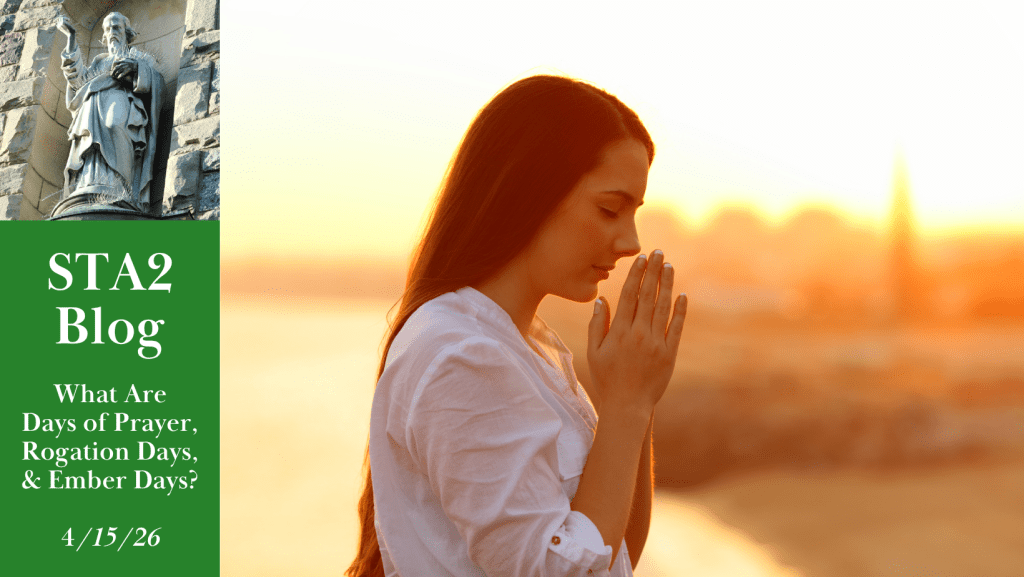
The Catholic Church throughout the world observes the Fourth Sunday of Easter as World Day of Prayer for Vocations; it falls on April 26 this year. There are a number of similar observances scattered throughout the year. (Don’t feel bad if you didn’t know that; they don’t always get the attention they deserve.) But what is a Catholic “day of prayer” and what should we do as individuals and as a parish to observe them?
Some history will be helpful here. In the past, the Latin Catholic Church (not the Eastern Catholic Churches) observed Ember and Rogation Days as opportunities to “entreat the Lord for the various needs of humanity, especially for the fruits of the earth and for human labor, and to give thanks to him publicly” (Universal Norms on the Liturgical Year and the Calendar 45). The Ember Days occurred in each of the four seasons (winter, spring, summer, and autumn) and were tied to the seasonal harvests. (Learn more about the Ember Days in this excellent article from the Diocese of Lansing.) Rogation Days occurred annually on April 25 and the three days preceding Ascension Thursday. They were observed with special Masses preceded by Litany of the Saints processions.
The former Ember and Rogation Days are still observed annually in the Extraordinary Form of the liturgy, in the Ordinariates for former Anglicans, and voluntarily by Catholics who find them spiritually beneficial. However, in the liturgical reforms that followed the Second Vatican Council, the Church decided to pursue a decentralized approach to days of prayer and penance: “In order that the Rogation Days and Ember Days may be adapted to the different regions and different needs of the faithful, the Conferences of Bishops should arrange the time and manner in which they are held. Consequently, concerning their duration, whether they are to last one or more days, or be repeated in the course of the year, norms are to be established by the competent authority, taking into consideration local needs” (Universal Norms 46).
In short, the authority to designate Ember and Rogation Days was delegated to national conferences of bishops and diocesan bishops so they could tailor the observances to the needs of their people, which may or may not be closely linked to the agricultural seasons. In many places, the terminology shifted to “days of prayer,” which include diocesan, national, and world days of prayer promoted by bishops, bishops’ conferences, and the pope, respectively. This change has also led to the proliferation of days of prayer for particular needs and issues.
For example, in the United States, the Ember and Rogation Days are not on our liturgical calendar, but we observe the Day of Prayer for the Legal Protection of Unborn Children on January 22, the anniversary of Roe v. Wade, with a special Mass. We also observe a number of other days of prayer; you can find a helpful list here. Not all of them have their own Mass. The Universal Norms say that “The Mass for each day of these celebrations should be chosen from among the Masses for Various Needs, and should be one which is more particularly appropriate to the purpose of the supplications” (47). Also, some of the world days of prayer coincide with relevant memorials, such as the World Day of Prayer and Awareness against Human Trafficking on the Memorial of St. Josephine Bakhita, or the World Day of the Sick on the Memorial of Our Lady of Lourdes.
So what does all this mean for us at St. Thomas? The Church is calling each of us personally to pray and do penance as we see fit on these days. Prayer is powerful, and there are so many important needs to bring before our Lord! The Church is also calling parishes to mark these days in ways that align with their parish cultures. Here at St. Thomas, we are going to start calling out national and world days of prayer and encouraging parishioners to observe them with prayer, fasting, and participation in the Mass. (If our bishop declares days of prayer, as our own Bishop Boyea did last June, we will draw attention to those, too.) Let us know if you have ideas about how we can observe the days of prayer together as a parish community!
Let’s get started: for those who attend the Extraordinary Form liturgy, or anyone interested, the next Rogation Day is Saturday, April 25. Then on Sunday, April 26, we will observe the World Day of Prayer for Vocations by kicking off the Traveling Vocation Crucifix initiative.
Keep an eye on the bulletin for information on upcoming days of prayer!
— Cory Lakatos, St. Thomas Director of Communications